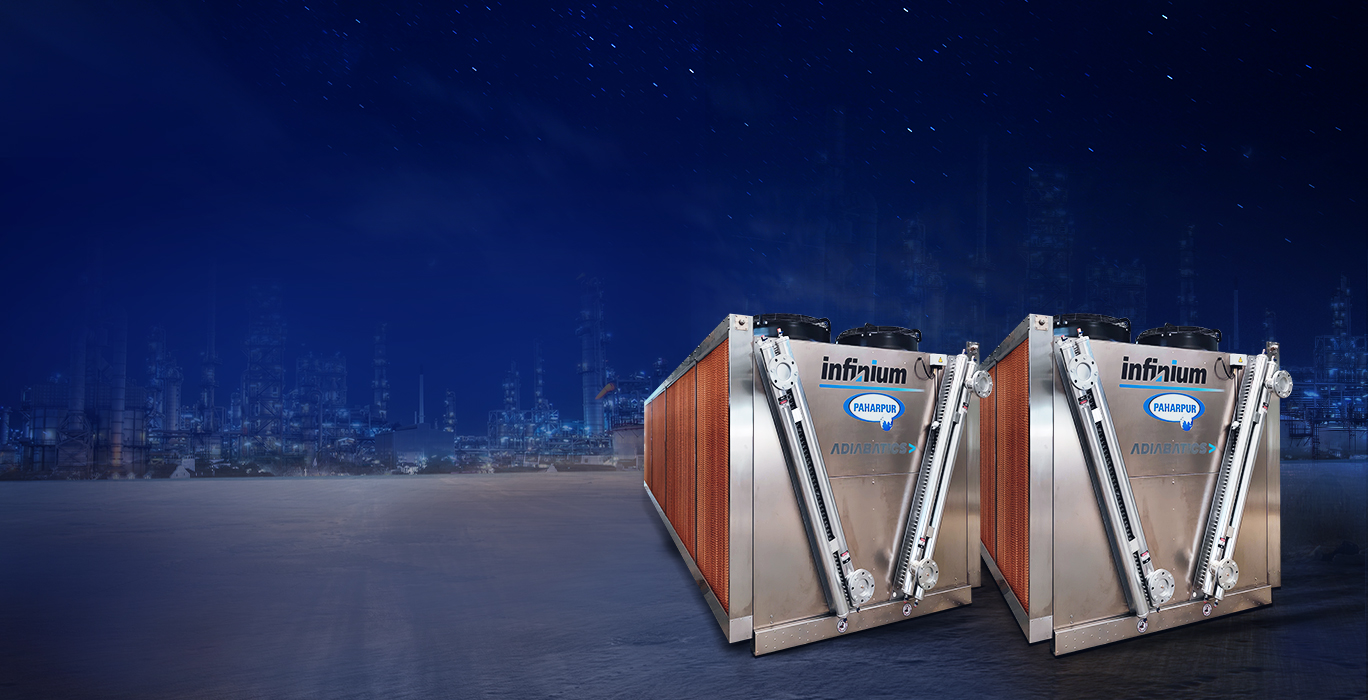
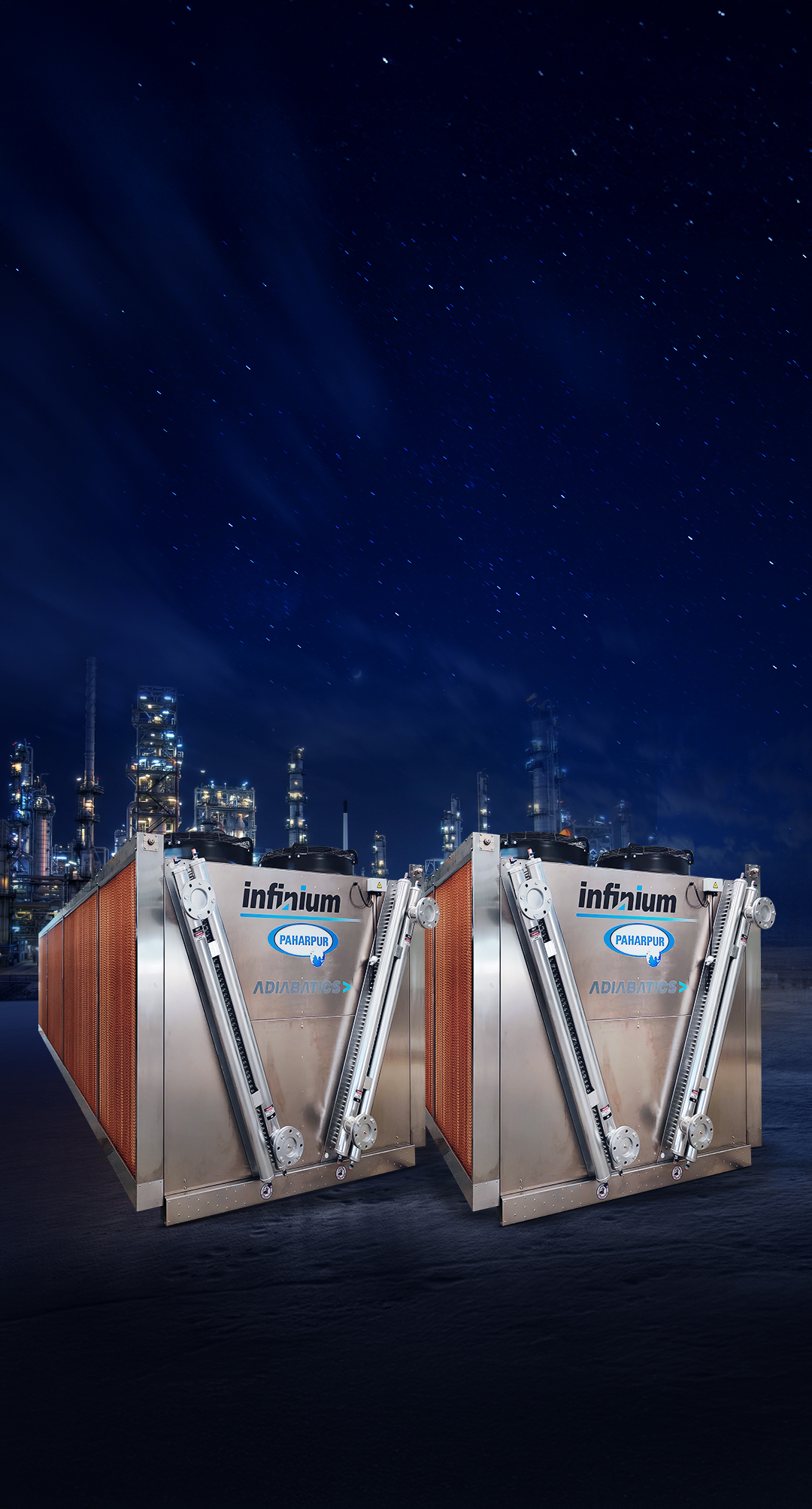



High-Precision Condensation with Minimal Water and Energy Use The Infinium NEO Adiabatic Condenser is engineered for high-efficiency condensation of refrigerants and specialty chemicals in precision cooling applications. Ideal for cold storage, food processing, dairy, meat, and seafood facilities, it combines adiabatic pre-cooling with a closed-loop heat exchanger circuit to deliver powerful thermal performance with up to 80% less water and 50% lower energy consumption compared to traditional cooling systems.
Smart adiabatic operation can deliver up to 95% less water use compared to conventional cooling systems.
EC fans and VFD technology can deliver up to 50% energy savings through intelligent airflow control.
Corrosion-resistant coils safely house the process-fluid circuit and protect system integrity.
Closed-loop operation and intelligent water management deliver zero Legionella risk.
Designed to safely handle refrigerants such as ammonia and Freon, as well as specialty fluids including Methylamine and Dimethyl Ether.
Smart controls enable remote system monitoring, diagnostics and predictive maintenance for improved reliability.
Infinium NEO automatically adjusts cooling performance in response to real-time ambient conditions, combining dry and wet operation with a sealed heat exchanger circuit.
In dry mode, integral VFD fan-motor assemblies reject heat without using water.
When conditions require additional cooling, adiabatic pads pre-cool intake air to improve heat rejection.
The sealed circuit safely handles high-pressure refrigerants and specialty process fluids while keeping the process fluid isolated.
EC fans and VFDs dynamically adjust airflow to match cooling demand and minimise energy consumption.
The BMS-compatible IP55-rated controller enables intelligent operation, remote monitoring and predictive maintenance.
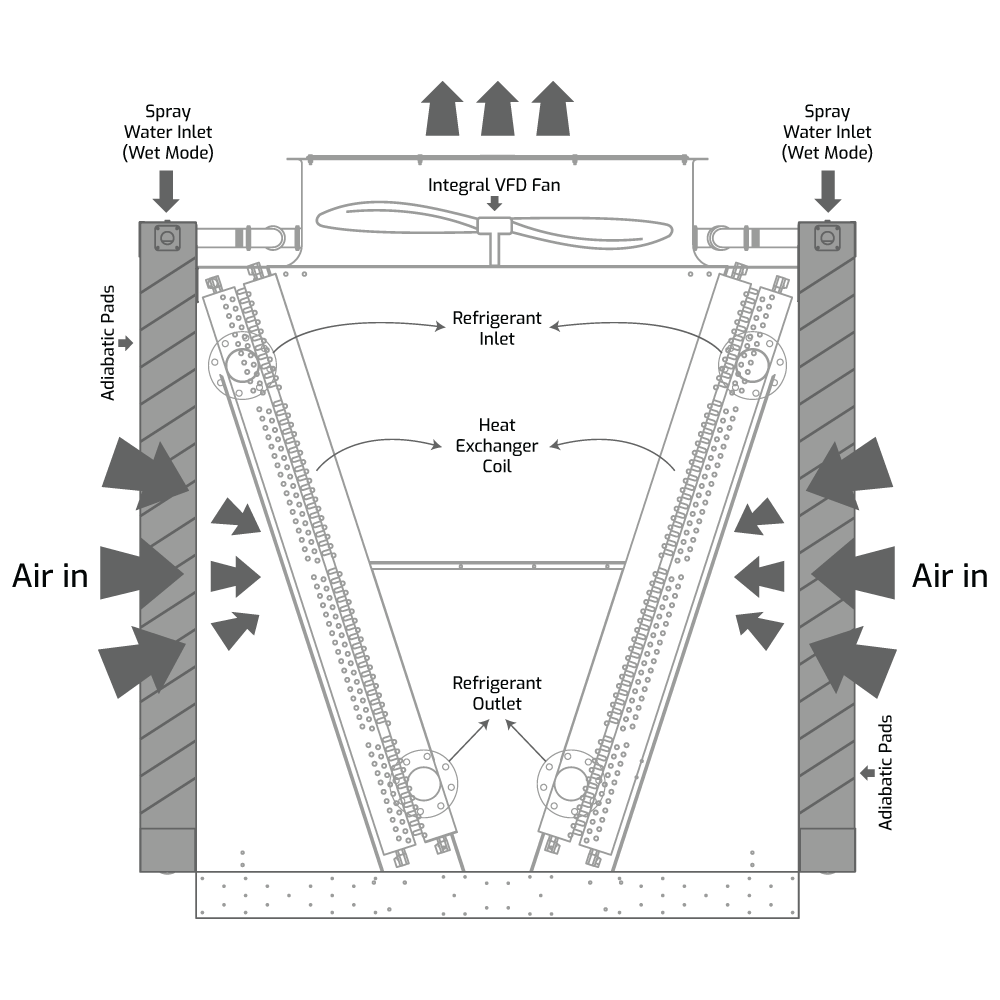
The unit is an intelligent hybrid cooling system that combines dry cooling with adiabatic pre-cooling to deliver efficient thermal performance while minimizing water consumption. The process fluid or refrigerant circulates through a closed-loop heat exchanger coil, ensuring that it remains isolated from atmospheric contaminants. An integral VFD fan continuously regulates airflow across the heat exchanger, while the adiabatic pads and spray water system operate only when additional cooling is required. This intelligent control strategy optimizes energy and water usage while consistently maintaining the desired process fluid temperature.
Under normal operating conditions, ambient air is drawn through the adiabatic pads and across the heat exchanger coil by the VFD-driven fan. During periods of moderate heat load or lower ambient temperatures, the unit operates in dry mode, where heat is rejected solely through forced air circulation. The closed-loop refrigerant transfers heat efficiently to the surrounding air, providing reliable cooling without consuming water.
As the ambient temperature or thermal load increases beyond the design threshold, the system automatically transitions to wet mode. Spray water is distributed over the adiabatic pads, cooling the incoming air through the principle of evaporative cooling before it reaches the heat exchanger. The resulting lower air temperature significantly enhances the coil's heat rejection capability, allowing the process fluid or refrigerant to achieve the required outlet temperature while using considerably less water than conventional evaporative cooling systems.
Once the cooling demand decreases or ambient conditions improve, the control system gradually discontinues water circulation and returns the unit to dry operation. By seamlessly switching between dry and wet modes, the system delivers optimum cooling performance, maximizes equipment efficiency, extends component life, and significantly reduces overall water and energy consumption.
Up to 95% water savings against conventional water-cooled systems.
Up to 50% energy savings against conventional air-cooled systems.

 SDG 6
- Clean water use via smart conservation
SDG 7
- Energy efficiency in large-scale cooling
SDG 13
- Reduced carbon emissions through lower power demand
SDG 6
- Clean water use via smart conservation
SDG 7
- Energy efficiency in large-scale cooling
SDG 13
- Reduced carbon emissions through lower power demand


Innovation that Moves Industry Forward Responsibly!