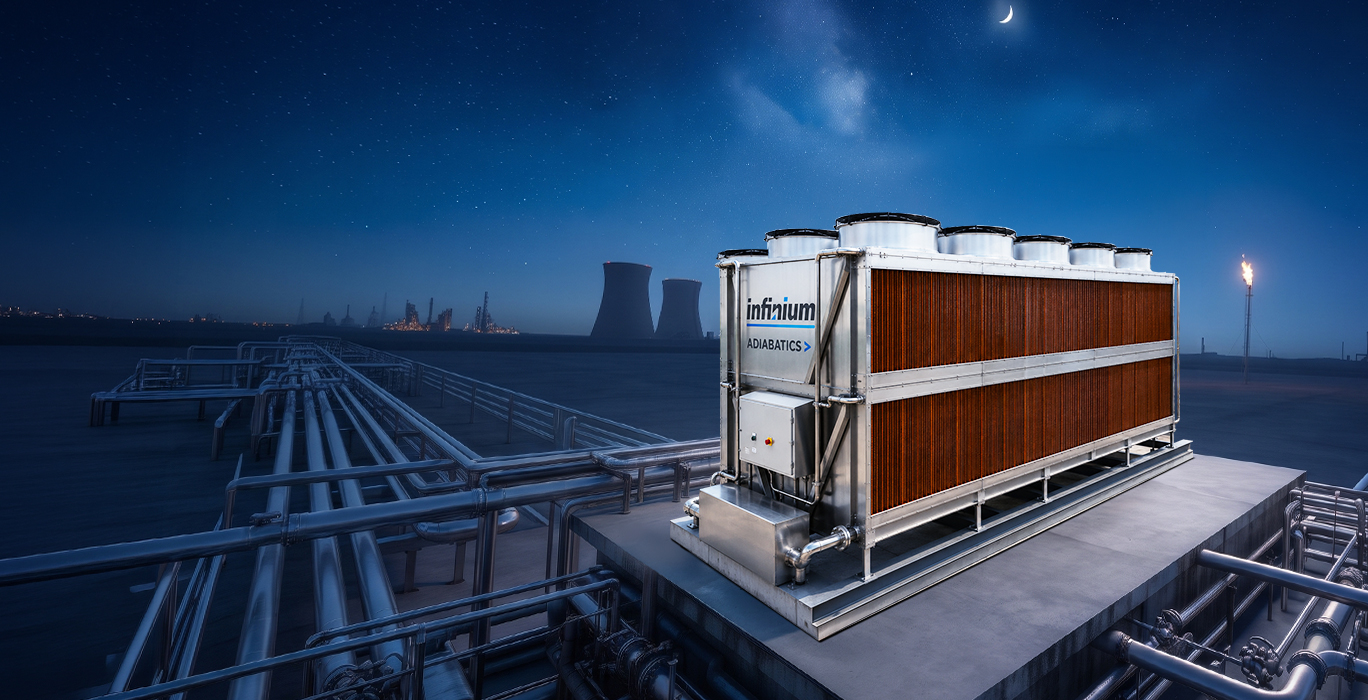
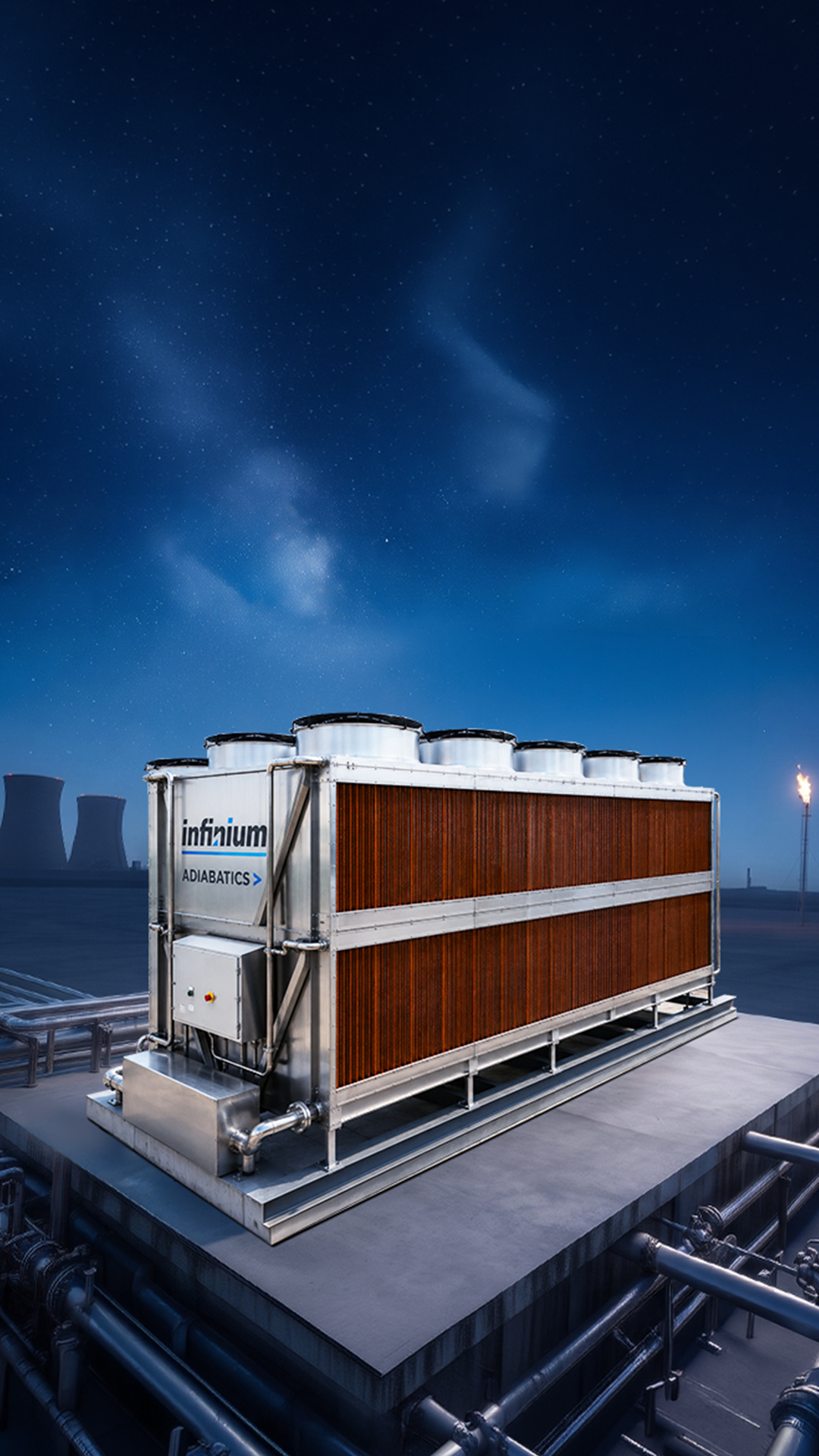



The Infinium NEO Double Stack is a space-optimized evolution of our flagship adiabatic cooling platform — purpose-built for industrial environments where capacity and space efficiency are critical. Featuring a vertically stacked dual-fan array, it delivers twice the cooling capacity in half the footprint, making it the perfect choice for urban installations, retrofits, or space-constrained utility yards. With Industry 4.0 automation, ultra-low water and energy consumption, and a closed-loop, Legionella-safe design, Infinium Neo Double Stack is engineered for peak thermal performance and minimal operational risk.
Ideal for dense urban rooftops, retrofits and industrial sites where available ground space is limited.
Smart adiabatic activation can reduce water use by up to 95%.
EC fans and VFD technology can deliver up to 50% energy savings through intelligent airflow management.
Corrosion-resistant coils house the process-fluid circuit within a sealed system for reliable operation.
Closed-loop operation and controlled water management provide zero Legionella risk.
Smart controls, BMS integration and remote diagnostics enable continuous monitoring and proactive maintenance.
Infinium NEO Double Stack uses a vertically stacked dual-fan configuration to increase cooling capacity without requiring additional ground space.
Dual fan arrays are positioned vertically to deliver twice the cooling capacity in a significantly reduced footprint.
EC or AC fans equipped with VFDs provide high airflow and responsive load management across changing operating conditions.
Both levels feature independent adiabatic pre-cooling systems, enabling simultaneous activation of wetted pads for enhanced air-side cooling.
The closed-loop system reduces water loss, limits exposure to airborne contaminants and maintains high hygiene standards.
A single intelligent control system optimises both cooling stacks with full BMS integration, remote diagnostics and seamless performance management.
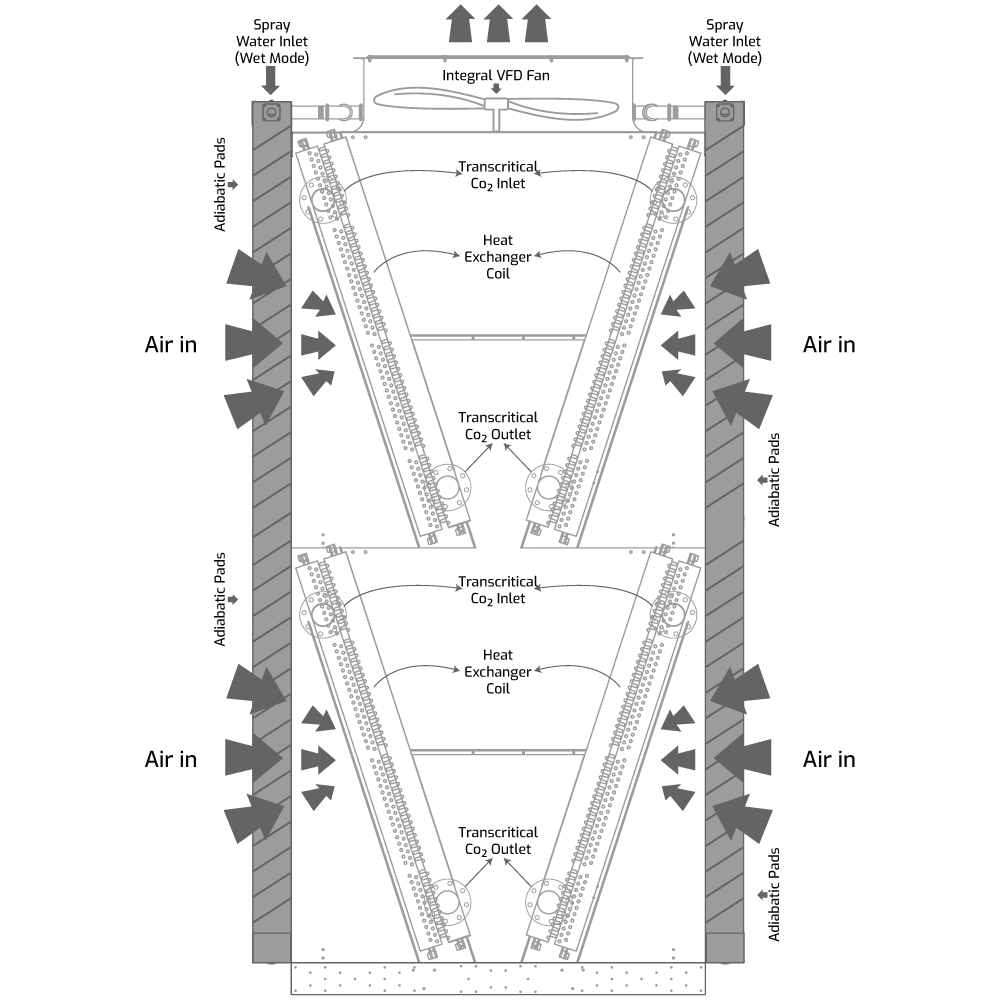
The unit is a high-capacity hybrid adiabatic cooling system engineered with a dual-stack heat exchanger configuration to maximize thermal performance while minimizing water and energy consumption. The process fluid circulates through closed-loop heat exchanger coils, ensuring that it remains completely isolated from the ambient environment. An integral VFD fan draws air uniformly across both heat exchanger sections, while the adiabatic pads and spray water system operate intelligently based on real-time cooling demand. This automated control system continuously optimizes fan speed and water usage to maintain the desired process fluid outlet temperature.
During normal operating conditions, ambient air is drawn through the adiabatic pads and across the upper and lower heat exchanger coils by the VFD-driven fan. In dry mode, heat is rejected entirely through forced air circulation without consuming water. The dual-stack coil arrangement increases the overall heat transfer surface area, enabling higher cooling capacity and improved thermal efficiency while maintaining low operating costs.
As the ambient dry bulb temperature or process heat load increases, the unit automatically transitions to wet mode. Water is distributed over the adiabatic pads, where evaporation pre-cools the incoming air before it passes through both heat exchanger sections. This cooler air significantly enhances the heat rejection capability of the coils, allowing the process fluid to achieve lower outlet temperatures while using substantially less water than conventional evaporative cooling systems. Once the cooling demand decreases or ambient conditions become favorable, the control system gradually deactivates the spray water system and returns the unit to dry operation. By seamlessly alternating between dry and wet modes, the system delivers reliable, high-capacity cooling, improves overall energy efficiency, reduces water consumption, and ensures consistent performance across varying operating conditions.
Up to 95% water savings against conventional water-cooled systems.
Up to 50% energy savings against conventional air-cooled systems.

 UN SDGs 6, 7, and 13
- Clean Water Efficiency, Affordable, Clean Energy and Climate Action & Low Emissions
Lower Carbon Footprint
- Reduced resource dependency & Smart energy and water automation
Zero Legionella Risk
- Fully sealed, hygienic cooling
Remote Monitoring
- Optimized for predictive maintenance and operational continuity
UN SDGs 6, 7, and 13
- Clean Water Efficiency, Affordable, Clean Energy and Climate Action & Low Emissions
Lower Carbon Footprint
- Reduced resource dependency & Smart energy and water automation
Zero Legionella Risk
- Fully sealed, hygienic cooling
Remote Monitoring
- Optimized for predictive maintenance and operational continuity


Innovation that Moves Industry Forward Responsibly!